
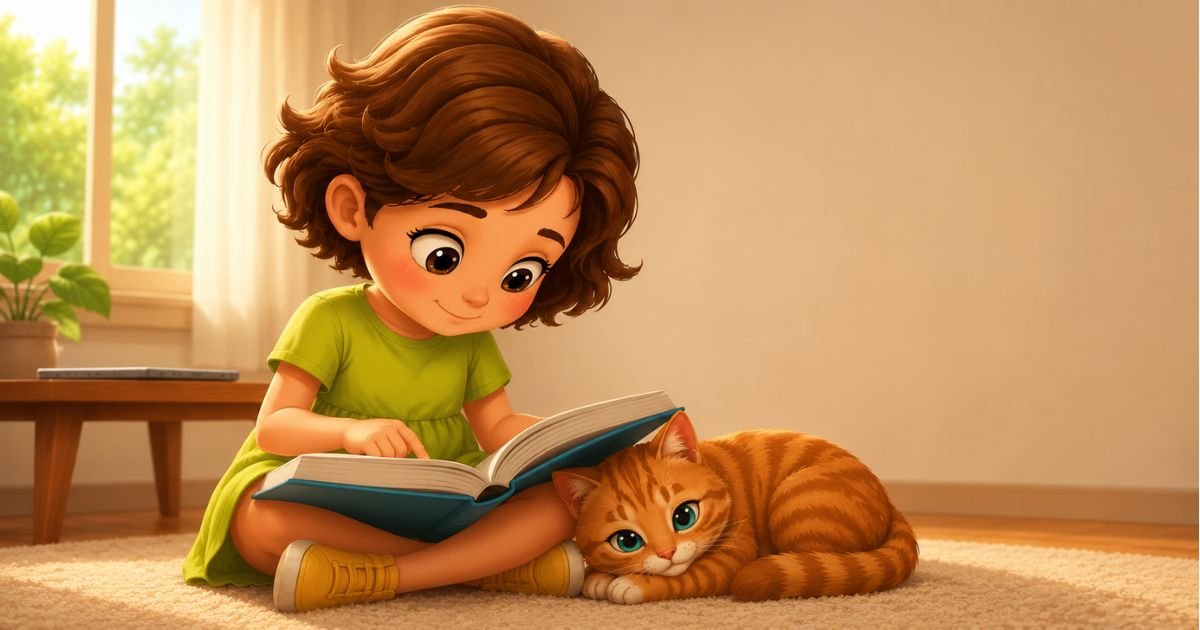
When it comes to science books for kids, the format matters more than most parents realize.
There’s a moment most parents recognize. Your kid is watching a video about the rainforest — bright, loud, thirty seconds per animal. They’re completely absorbed. Ten minutes later you ask what they learned, and they can’t tell you.
It’s not that they weren’t paying attention. It’s that attention and learning aren’t the same thing.
What changes when there’s paper
Something different happens when a child reads a book about biology. The pace slows down. There’s no autoplay pulling them to the next thing. They can go back to the page with the butterfly, look at it again, notice the tiny hairs on its legs they missed the first time.
Researchers have a name for this. A 2021 meta-analysis of 39 studies covering nearly 2,000 children ages 1 to 8 found that when a book was the same in print and on screen, kids understood less from the screen. The literature calls it the “screen inferiority effect.”
The same study found something else worth knowing: a parent reading a print book alongside a child was more effective than any of the interactive features the digital versions offered.
A book waits. That’s its quiet superpower. It sits there and lets the child set the speed.
Kids ages 5–8 read with their hands
If you’ve watched a six-year-old read, you’ve seen this. They point. They trace the diagram with a finger. They flip back two pages to compare the frog to the fish.
That physical relationship with the page isn’t a quirk — it’s how young children build memory. Turning a page creates a spatial map in their head. The picture of the roots was on the left side, near the beginning. Screens erase that map. Everything happens in the same rectangle.
This is part of why science books for kids in this age range tend to work better in print. The content is visual and spatial by nature. Where things are on the page becomes part of what the child remembers.
Reading together is different from watching together
Here’s something that gets overlooked. When a parent and a child watch a video, they mostly sit in silence. When a parent and a child read a book, they talk.
You stop and ask, “Why do you think the plant grows toward the window?” Your kid asks, “What’s that thing on the leaf?” You don’t know either, so you look it up together.
That back-and-forth is the learning. Not the facts on the page — the conversation the page starts. Biology is especially good at this because every page has something to point at. A book is an excuse to stay in one place and wonder about the same thing at the same time.
Screens aren’t the enemy
None of this means screens are bad. A good nature documentary can show a child something a book never could — a hummingbird’s wings in slow motion, a seed cracking open in time-lapse.
The problem isn’t the screen. It’s the assumption that a screen is the default.
For kids ages 5–8, when the goal is understanding rather than exposure, print still wins. Not because it’s old-fashioned. Because the format matches how their brains work at this age.
The kind of book that works
Not every science book for kids does this well. Some are just screens on paper — busy layouts, too much text, facts stacked without a thread.
The ones that work tend to share a few things. Illustrations that reward a second look. Language written for a child, not simplified for one. And white space — room on the page for the eye to rest, which is really room for the mind to catch up.
They also leave things unfinished. Not everything explained. A good question at the end of a section is worth more than a paragraph of answers.
Where we’re going with this
We built Biology Made Simple for Kids around this idea — that a child ages 5–8 doesn’t need more information about living things. They need a better place to be curious about them.
The paperback edition is coming soon. If you’ve been waiting for a physical copy to read together, it won’t be long.
Until then, the best biology book in your house might be the window. Sit next to your kid and look out of it for a while. Ask what’s alive out there, and how they know.
That’s where all of this starts anyway.
Curious Lab Press is an independent children’s science publisher. We make books that help kids ages 5–8 stay curious about the world. Learn more about who we are.